If you are searching for a complete mutual fund holding mode broker list, finding out whether your platform uses Statement of Account (SOA) or Demat holding can be surprisingly difficult. Most platform websites hide these details in their FAQs or terms of service. This guide breaks down the holding modes and plan types of 20+ major Indian brokers and platforms.
SOA vs Demat Mutual Funds: Which Mode Does Your Broker Use?
Mutual fund units in India are held in one of two formats: Statement of Account (SOA) or Demat mode (for a detailed comparison, read our guide on SOA vs Demat Mutual Funds). SOA means your units are registered directly with the mutual fund house (AMC) and serviced by registrars like CAMS or KFintech. Demat mode means your units are held electronically in a CDSL or NSDL depository account via your broker. SOA is generally free and highly portable, while Demat consolidates your funds with stocks but can trigger depository fees during redemptions.
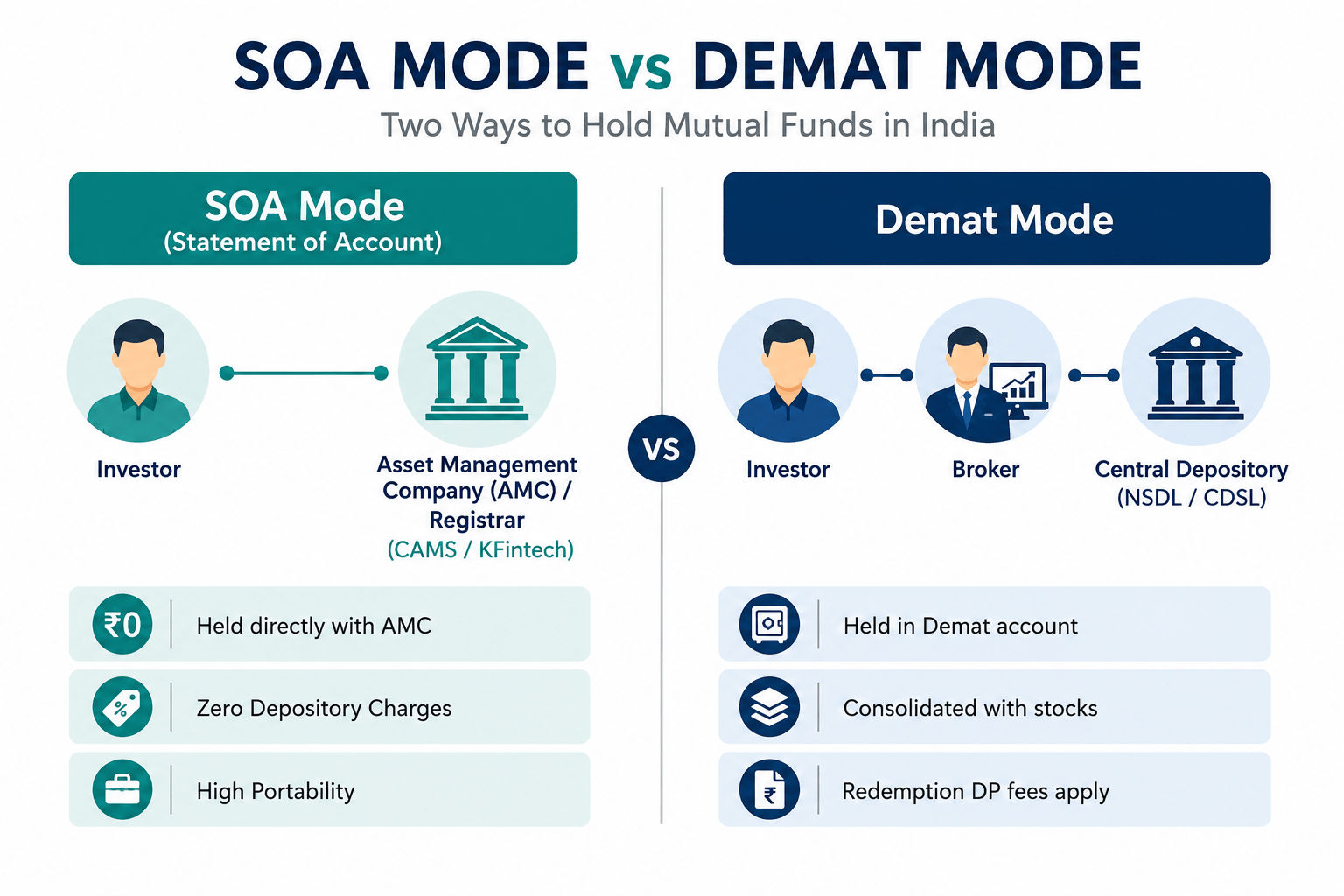
Meera, a 28-year-old software developer in Pune, recently wanted to check where her mutual funds are stored. Her SOA investments appeared on MF Central instantly, but her Demat investments were only visible in her CDSL statement. She realized her Demat holdings are locked to her broker’s platform for day-to-day transactions.
Indian Mutual Fund Platforms: SOA vs Demat and Plan Type Comparison
Brokers in India configure their systems differently. Traditional banks usually offer SOA-based regular plans to earn commissions, while stockbrokers mandate Demat to leverage their trading accounts. Newer platforms offer a mix of both.
Here is the complete comparison table of major platforms:
Digital Platforms (Non-Brokers)
| Platform/Broker | Holding Mode (SOA vs Demat) | Plans Offered (Direct vs Regular) | Key Caveats & Notes |
|---|---|---|---|
| Kuvera | SoA (Source) | Direct (Source) | Held directly with the AMC. Highly portable and zero DP charges. |
| ET Money | SoA (Source) | Direct (Source) | Traditional SoA holding serviced via CAMS and KFintech. |
| MF Central | SoA (Source) | Direct (Source) | Official platform of CAMS and KFintech. SOA only. |
| MF Utility (MFU) | SoA (Source) | Both (Source) | Transaction aggregator using SOA mode. |
| Scripbox | SoA (Source) | Both (Source) | Offers regular plans by default. Direct plans are available for portfolios exceeding ₹50 Lakhs. |
| Fisdom | SoA | Both | B2B2C integration. Offers a mix of regular and direct plans. |
Discount Brokers
| Platform/Broker | Holding Mode (SOA vs Demat) | Plans Offered (Direct vs Regular) | Key Caveats & Notes |
|---|---|---|---|
| Zerodha Coin | Demat (Source) | Direct (Source) | Holds units in CDSL. Zero commissions but subject to CDSL DP charges on redemptions. |
| Groww | Both (Demat-first default) (Source) | Direct (Source) | New investments are Demat by default. Users can toggle to SoA in account settings. |
| Paytm Money | SoA (Source) | Direct (Source) | Holds units in SoA format at the AMC, but requires a Demat/broking account to generate a UCC. |
| Dhan | Both (Source) | Direct (Source) | Offers option to choose SOA or Demat holding mode at order placement. |
| INDmoney | Both (SoA default) (Source) | Direct (Source) | Holds units in SoA/Physical by default. Can switch to Demat in profile settings. |
Bank-Based Brokers & Traditional Wealth Managers
| Platform/Broker | Holding Mode (SOA vs Demat) | Plans Offered (Direct vs Regular) | Key Caveats & Notes |
|---|---|---|---|
| SBI / SBICAP Sec. | Demat (SBICAP) / Both (Source) | Regular | Regular plans only. SBICAP defaults to CDSL Demat (Source). |
| HDFC Bank / HDFC Sec. | Both (Bank) / Demat (Sec.) (Source) | Regular (Source) | Traditional branches use SOA; SmartWealth app (Source) uses Demat. |
| ICICI Bank / ICICI Direct | SoA (Bank) / Both (Direct) (Source) | Regular (Source) | ICICI Direct supports both modes; banks use traditional SOA. |
| Axis Bank | SoA | Regular | Regular plans only. Held via AMC folios in SOA mode. |
| Kotak Mahindra / Cherry | Both (Source) | Regular (Source) | Kotak Cherry consolidates Demat and SoA holdings. |
| NJ Wealth | Both (Source) | Regular (Source) | Offline distributor using both modes; earns trail commissions. |
| Prudent Corporate | SoA | Regular | Folio holdings in SOA; regular plans only. |
| JM Financial | Both (Source) | Regular | Full-service broker using both modes for regular plans. |
| Aditya Birla Finance | SoA | Regular | Wealth branch offering regular plans. |
| Bajaj Capital | SoA | Regular | Traditional offline agent offering regular plans. |
| IDBI Bank | SoA | Regular | Traditional retail bank folios held in SOA. |
Direct vs Regular Mutual Funds: The Real Cost of Legacy Platforms
While holding modes (SOA vs Demat) affect your convenience and porting process, plan types (Direct vs Regular) directly impact your wallet. Direct plans have lower expense ratios because they do not pay distributor commissions. Regular plans carry a trail commission of 0.5% to 1.5% annually, which is paid out of your investment pool to the broker.
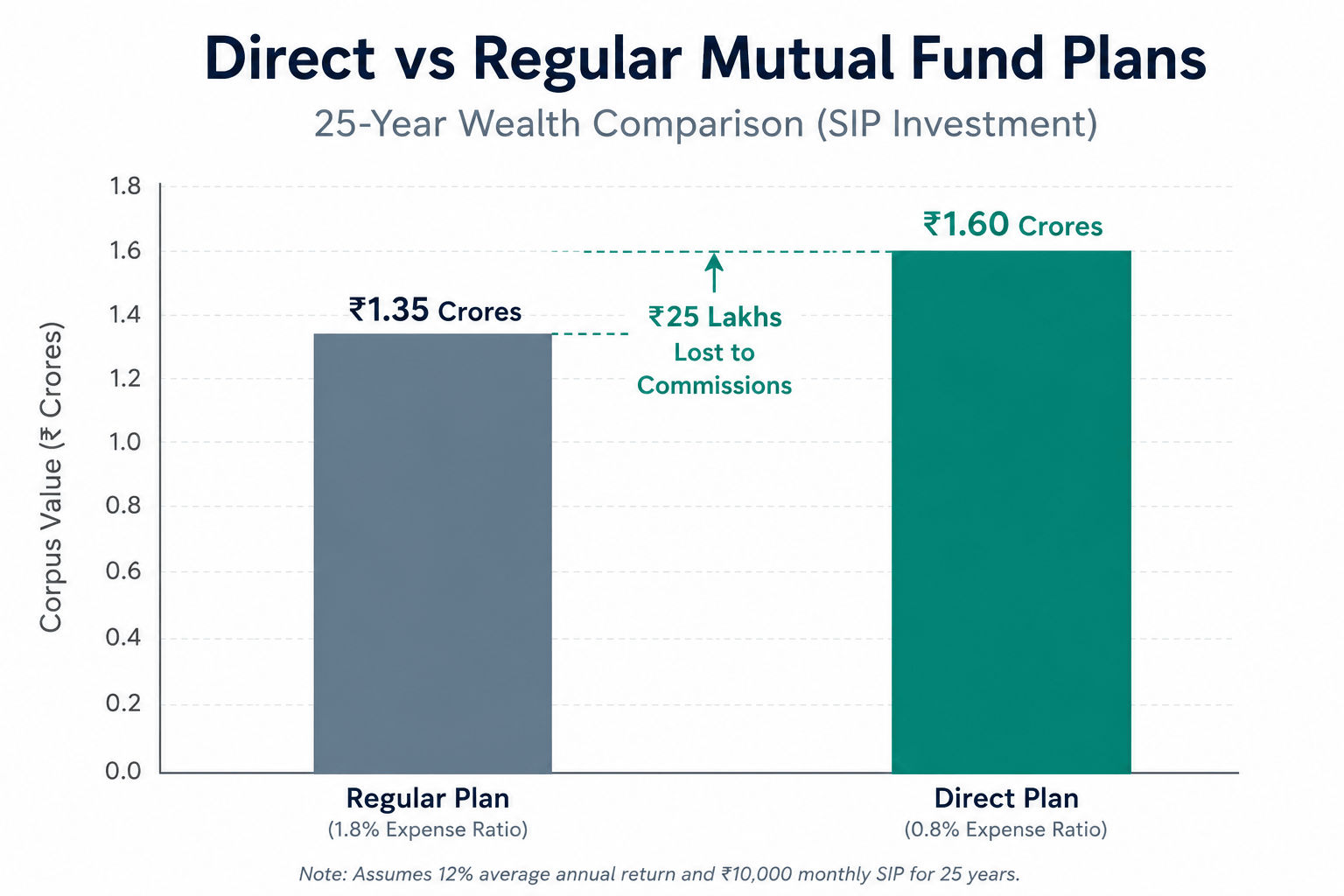
To understand the compounding impact, consider Rohan, a 25-year-old developer in Bengaluru who invests ₹10,000 every month. If Rohan chooses a regular plan with a 1.8% expense ratio, his portfolio grows to ₹1.35 Crores after 25 years assuming a 12% underlying return. If he chooses the Direct plan version of the same fund with a 0.8% expense ratio, his portfolio grows to ₹1.60 Crores. The 1% difference in charges costs Rohan ₹25 Lakhs in lost compounding.
Key observations
Direct-first platforms offer direct plans, while legacy brokers offer regular plans. Direct-only apps (like Zerodha Coin, Groww, Paytm Money, Kuvera, ET Money, and Dhan) provide zero-commission direct plans. Traditional banks and legacy distributors (like SBI, HDFC, ICICI, Axis, NJ Wealth, and Prudent) restrict retail clients to regular plans to earn trail commissions.
Holding modes depend heavily on stock trading integration. Platforms that started as stock brokers (Zerodha, HDFC Securities, SBICap Securities) mandate or default to Demat holding for mutual funds to utilize their CDSL/NSDL integration. Platforms that started as mutual fund-first apps (Kuvera, ET Money, Paytm Money) use SOA mode exclusively to avoid depository charges.
Hybrid platforms offer the most flexibility. Groww, Dhan, ICICI Securities, and Kotak Mahindra Bank allow users to hold units in either Demat or SOA modes. Dhan, in particular, stands out by letting investors select their preferred holding mode at the time of order placement.
Brokers often implement unique rules that confuse investors. For instance, Zerodha Coin holding is CDSL Demat only, meaning you cannot edit your folio directly on CAMS or MF Central. When you redeem units on Zerodha Coin, you will pay a CDSL DP transaction fee.
Groww has transitioned to a Demat-first default for new mutual fund orders. If you prefer SOA, you must actively opt out in your Groww account settings. Existing SOA holdings are not converted unless you request it.
How to Find Your Current Holding Mode and Switch?
You can easily identify your current holding format by reading your monthly Consolidated Account Statement (CAS) sent by CDSL, NSDL, or RTAs. If your mutual funds appear under the Demat section, they are held in Demat mode. If they appear under the Statement of Account folio details, they are held in SOA mode.
If you want to move your holdings, you can request conversion. Moving from SOA to Demat requires submitting a Demat Request Form (DRF) to your broker. Switching back to SOA is called rematerialization, which requires an RRF form. If you want to switch from regular plans to direct plans, remember that the switch is treated as a redemption and a fresh purchase, which triggers capital gains tax (STCG or LTCG) on any gains.
Questions people ask about broker holding modes
Can I convert my Demat mutual funds back to SOA (Statement of Account)? Yes. You can convert Demat mutual fund units back to SOA format through rematerialization. You must submit a Rematerialization Request Form (RRF) to your broker’s Depository Participant team, which coordinates with the AMC to reissue the units in SOA folio format.
Do I need a Demat account to invest in direct mutual funds? No. A Demat account is not required for direct mutual funds. Platforms like Kuvera, ET Money, and MF Central let you buy direct plans in SOA format without a Demat account. Only stockbroker platforms like Zerodha Coin mandate a Demat account.
Are there charges for holding mutual funds in Demat mode? Yes. While mutual fund transactions carry no brokerage, holding units in Demat mode can trigger annual maintenance charges (AMC) for your Demat account (ranging from ₹200 to ₹500/year) and depository participant (DP) charges of ₹13.50 to ₹20 per redemption.
Can I access my Demat mutual funds on MF Central? No. MF Central only tracks and services mutual funds held in Statement of Account (SOA) format. If your mutual fund units are held in Demat format through a broker, they will not show up on the MF Central dashboard for transactions.
What happens to my mutual funds if my broker goes bankrupt? Your investments remain safe. In SOA mode, your units are held directly with the AMC. In Demat mode, your units are held in your name in CDSL or NSDL depositories. The broker is just an intermediary; their bankruptcy does not affect your ownership.
Knowing how your platform holds your mutual funds helps you avoid unexpected DP charges and maintain portability. If you are starting fresh, check your platform’s default settings before committing your cash.
This article is for educational purposes only and does not constitute investment advice. Please consult a SEBI-registered investment advisor before making financial decisions.