You want to run sophisticated strategies like long-short equity, but the ₹50 lakh ticket for Portfolio Management Services (PMS) is out of reach. Traditional mutual funds, meanwhile, cannot short the market during a correction. SEBI introduced Specialized Investment Funds (SIFs) in April 2025 to fill this gap, and by mid-2026, the category has already crossed ₹12,000 crore in assets under management.
What is a Specialized Investment Fund (SIF)?
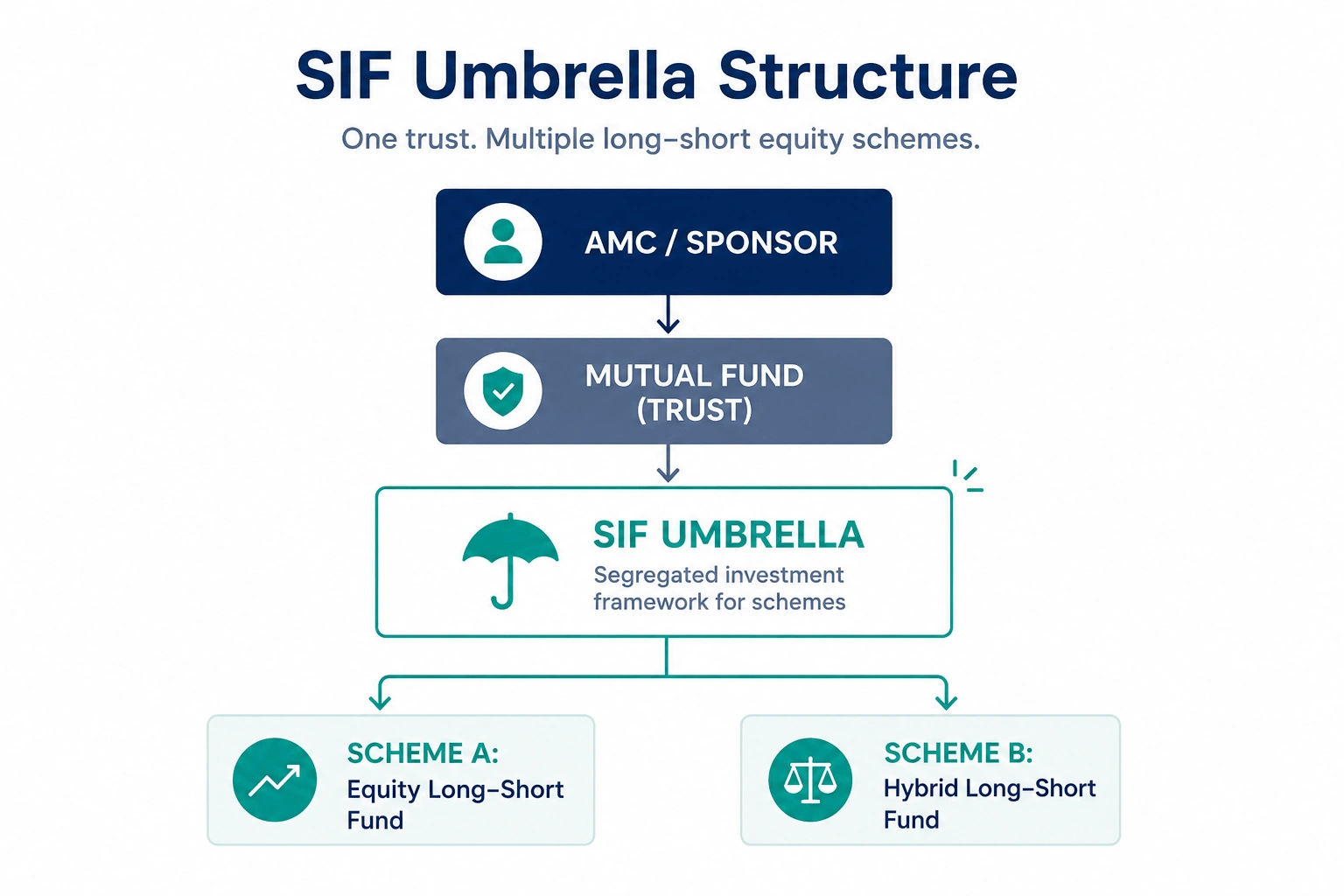
A Specialized Investment Fund is a SEBI-regulated mutual fund vehicle that lets Asset Management Companies (AMCs) run strategy-specific portfolios with tools that traditional funds cannot use. The defining difference: SIFs can hold unhedged derivative positions, giving fund managers the ability to profit from falling markets or hedge against downturns.
Each AMC launches SIFs under a separate “umbrella” brand to keep them distinct from its retail mutual fund lineup. The entry barrier is deliberate. You need a minimum of ₹10 lakh per PAN, aggregated across strategies under a single AMC. If you hold accreditation from a SEBI-recognized agency, that drops to ₹1 lakh.
Amit, a 29-year-old tech lead in Bengaluru earning ₹25 LPA, has maxed out his regular equity mutual funds. He wants exposure to a fund that can hedge market downturns, but the ₹50 lakh PMS ticket is well beyond his savings. A SIF Equity Long-Short Fund at ₹10 lakh fits his budget and his goal.
One thing to clear up early: SIFs are not sectoral or thematic mutual funds. Sectoral funds are traditional long-only equity funds focused on a single sector (IT, banking) with entry as low as ₹500. SIFs are strategy-driven vehicles that use complex derivatives. Entry starts at ₹10 lakh.
SEBI Rules & Regulatory Framework for SIFs
SEBI has set tight boundaries to keep SIFs disciplined. For equity-oriented SIFs, the scheme must invest 65% to 80% of assets in equity. The distinctive feature is the allowance for unhedged short positions — up to 25% of Net Asset Value (NAV) — using derivatives like futures and options.
On the debt side, concentration limits are strict. A SIF cannot hold more than 20% in AAA-rated bonds, 16% in AA-rated, and 12% in A-rated instruments, with an optional 5% board-approved buffer. No single sector’s debt or money market exposure can exceed 25%.
Here is how this plays out in practice. Vivek manages a SIF Equity Long-Short fund. He allocates ₹80 lakh to quality large-cap stocks and takes ₹20 lakh of unhedged short positions via Nifty futures to protect against a near-term correction. That ₹20 lakh sits within SEBI’s 25% cap, so the portfolio stays compliant.
A common fear: “unhedged shorting” sounds like the fund can take unlimited leverage, the way offshore hedge funds do. It cannot. The 25% cap on unhedged shorts keeps derivative exposure bounded. This is not a fund that can go 200% long and 100% short. Think of it as a conventional equity fund with a small, regulated sleeve of tactical hedging.
Why SIFs Are Gaining Traction: Key Benefits
The single biggest draw for High-Net-Worth Individuals (HNIs) is tax efficiency. SIFs enjoy the Section 10(23D) tax exemption under the Income Tax Act, meaning the fund itself pays zero tax. All tax liability passes to you only when you redeem your units.
Compare that to Category III AIFs, which are taxed at the fund level at the maximum marginal rate — up to 42.7%. With an equity-oriented SIF, your Long-Term Capital Gains (LTCG) are taxed at just 12.5% on gains exceeding ₹1.25 lakh, and Short-Term Capital Gains (STCG) at 20%.
Rohit, an HNI in Mumbai in the 42.7% bracket, wants a long-short strategy. If he puts money into a Category III AIF, gains are taxed at the peak slab at the fund level before he sees returns. Instead, he allocates ₹20 lakh to an equity-oriented SIF and holds for 14 months. His gains are taxed at 12.5% plus cess — a difference that compounds significantly over time.
There is another structural benefit worth noting. In a standard PMS, every trade the manager executes triggers immediate capital gains tax for you. SIFs shield you from this tax drag by deferring all liability until you actually redeem your units.
Global Precedents: Luxembourg SIF vs. US Liquid Alts
The SIF acronym exists globally, but SEBI’s version is structurally different from its international counterparts.
A Luxembourg Specialised Investment Fund is an offshore alternative fund reserved for professional and institutional investors. It has a minimum investment requirement of €125,000. Over 1,500 active Luxembourg SIFs manage an estimated €650 billion+ in assets. They can invest in virtually any asset class — private equity, real estate, distressed debt — with no strict leverage cap. They pay a nominal 0.01% annual subscription tax and can market across all EU states via AIFMD passporting.
The closest parallel to Indian SIFs is the US “Liquid Alts” category: SEC-registered mutual funds under the Investment Company Act of 1940 that use long/short equity and managed futures within a daily-liquid, regulated wrapper. In 2024, the US liquid alts space attracted roughly $92 billion in net inflows.
Indian SIFs sit between these two. They are onshore and mutual-fund-regulated, with the 25% unhedged short cap keeping them tightly bounded — closer to US Liquid Alts in spirit, but without the decades of manager track record data the US market offers. If you are an NRI investor familiar with 1940 Act funds like the AQR Long-Short Equity Fund, the Indian SIF will feel structurally familiar.
One misconception: investors assume the Indian SIF is equivalent to the Luxembourg SIF. It is not. Luxembourg SIFs are private, lightly supervised, and can hold illiquid assets. Indian SIFs are publicly regulated, liquid mutual fund schemes with tight concentration limits.
SIF vs. Traditional Mutual Funds vs. PMS vs. AIF
| Parameter | SIF | Traditional MF | PMS | AIF (Cat III) |
|---|---|---|---|---|
| Minimum Investment | ₹10 Lakh (₹1L accredited) | ₹500 – ₹1,000 | ₹50 Lakh | ₹1 Crore |
| Asset Structure | Pooled MF Trust | Pooled MF Trust | Individual Demat | Pooled Private Fund |
| Strategy Flexibility | Long-Short, Sector Rotation | Long-Only (hedging only) | Highly Customized | High Leverage, Custom |
| Leverage/Short Limit | Max 25% unhedged short | No unhedged shorting | Varies, can use leverage | Up to 200% leverage |
| Tax Treatment | MF rates (12.5% LTCG, 20% STCG) | MF rates (12.5% LTCG, 20% STCG) | Taxed per trade at client level | Fund-level tax (up to 42.7%) |
| Liquidity | Open-ended or Interval | Daily (open-ended) | Client discretion / lock-ins | Often closed-ended / lock-ins |
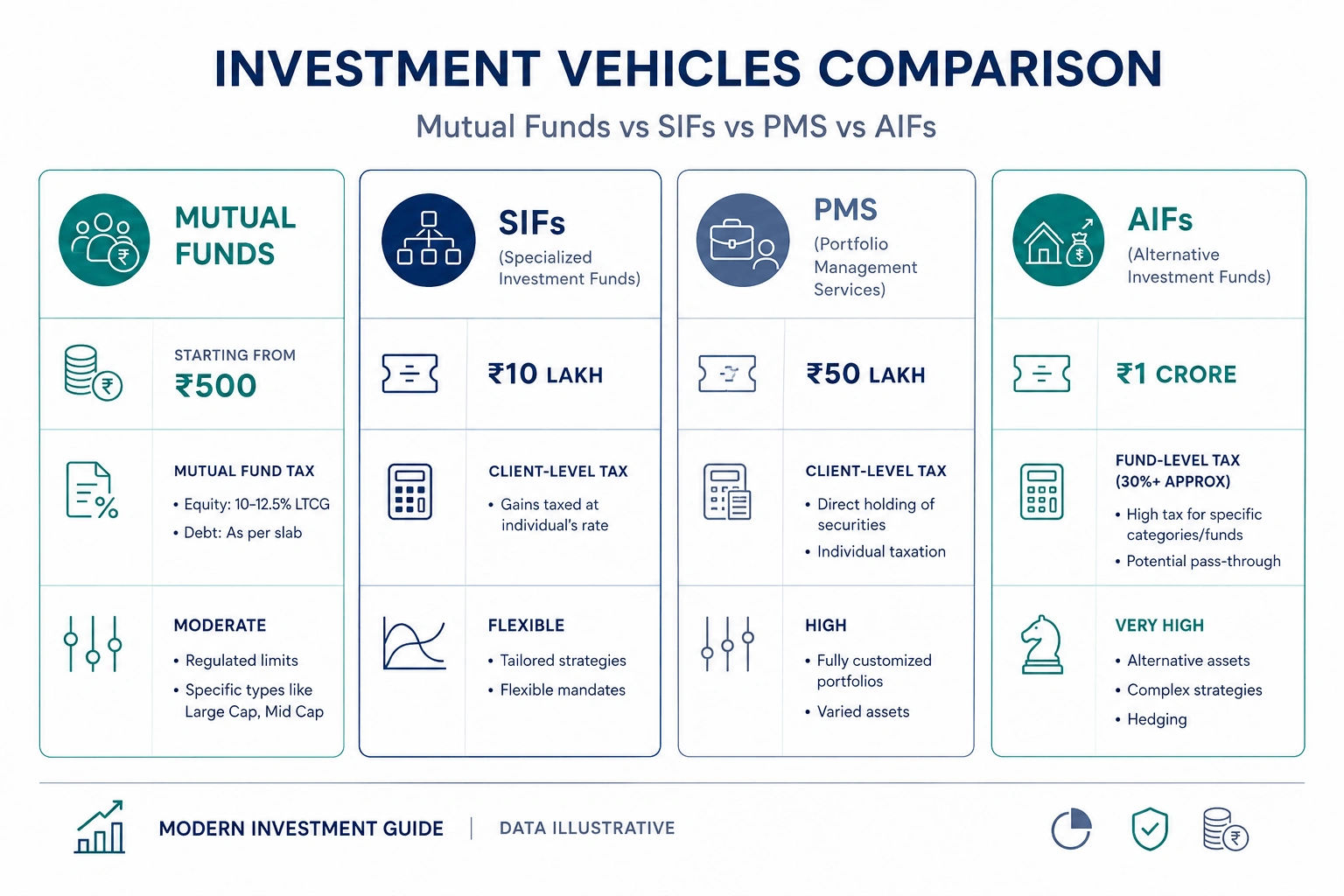
When comparing returns across these vehicles, XIRR gives the most accurate annualized picture.
Available SIF Schemes and Performance (2025–2026)
The SIF category has grown fast. Industry AUM jumped from ₹6,501 crore in January 2026 to ₹12,255 crore by April 2026 — nearly doubling in three months.
Here are the key launches:
- Edelweiss Altiva SIF: Altiva Hybrid Long-Short Fund (launched October 2025, +6.54% since inception as of May 2026, interval structure, 1% exit load within 15 days). Also launched Altiva Equity Ex-Top100 Long-Short Fund (November 2025, open-ended).
- Quant QSIF: Equity Long-Short Fund (launched October 2025, +3.54% since inception as of May 2026, open-ended). Hybrid Long-Short Fund (October 2025, interval). Active Asset Allocator SIF (April 2026).
- SBI Magnum SIF: Magnum Hybrid Long-Short Fund (launched October 2025, +2.55% since inception as of May 2026, interval structure).
- Aditya Birla Apex SIF: Apex Hybrid Long-Short Fund (launched March 2026).
Expense ratios (TER) across these schemes average 1% to 2% per annum. Exit loads are typically 1% if redeemed within 15 days, with no load thereafter. Hybrid SIFs often use interval structures, meaning you can only redeem during designated weekly or monthly windows.
If you want to set up a Systematic Investment Plan (SIP), Systematic Transfer Plan (STP), or Systematic Withdrawal Plan (SWP), you must first meet the ₹10 lakh initial threshold. After that, subsequent SIP or STP transactions can be smaller amounts, as long as your total holding with that AMC stays above ₹10 lakh.
Pooja, 28, decides to invest in the Quant QSIF Equity Long-Short Fund. She makes a lump sum of ₹10 lakh to activate her account, then sets up a monthly SIP of ₹10,000 to steadily build her position.
Many investors assume SIFs have a 3-year lock-in like ELSS or Category I/II AIFs. They do not. SIFs have no mandatory lock-in period — they are either open-ended or interval-based with a short 15-day exit load window.
Key Risks and Limitations of SIFs
SIFs carry higher risk than traditional mutual funds. The use of derivatives introduces leverage that can amplify losses if the manager’s market calls are wrong. Even with the 25% cap, a poorly timed short position can drag down returns.
Liquidity risk is real for interval-structured funds. If you invest in a hybrid SIF with monthly redemption windows, you cannot exit on a random business day during a market panic. You must wait for the next designated window.
Concentration risk is another concern. Given the debt caps (20% AAA, 16% AA, 12% A), a credit downgrade in a significant holding can hit the portfolio harder than it would in a diversified debt mutual fund.
Operational risk exists too. SIFs rely on complex derivative instruments that require accurate daily mark-to-market, margin management, and counterparty settlement. An AMC with weak back-office infrastructure can face execution errors or settlement failures that affect NAV accuracy.
SIFs are also a new product category. While early returns from late 2025 through mid-2026 show capital protection during drawdowns, there is no long-term track record across a full multi-year market cycle. Treat early performance data with caution.
The common misconception here: the 25% short limit guarantees the fund will never lose money in a crash. It does not. Short positions reduce net market exposure but do not eliminate risk. Poor manager execution can still result in meaningful losses.
Practical Guide for Investors: Due Diligence, Allocation, and Suitability
Before committing ₹10 lakh, run through a basic checklist:
- AMC credentials: Does the AMC have a 3-year track record? If not, does the fund manager have over 10 years of verified experience?
- Fund structure: Is the scheme open-ended or interval-based? This determines how quickly you can exit.
- Strategy mandate: Does the fund’s actual investment mandate match your expectations? A “hybrid long-short” fund has a different risk profile than an “equity long-short” fund.
- Exit load terms: Check the specific Scheme Information Document (SID) for the exit load period and percentage.
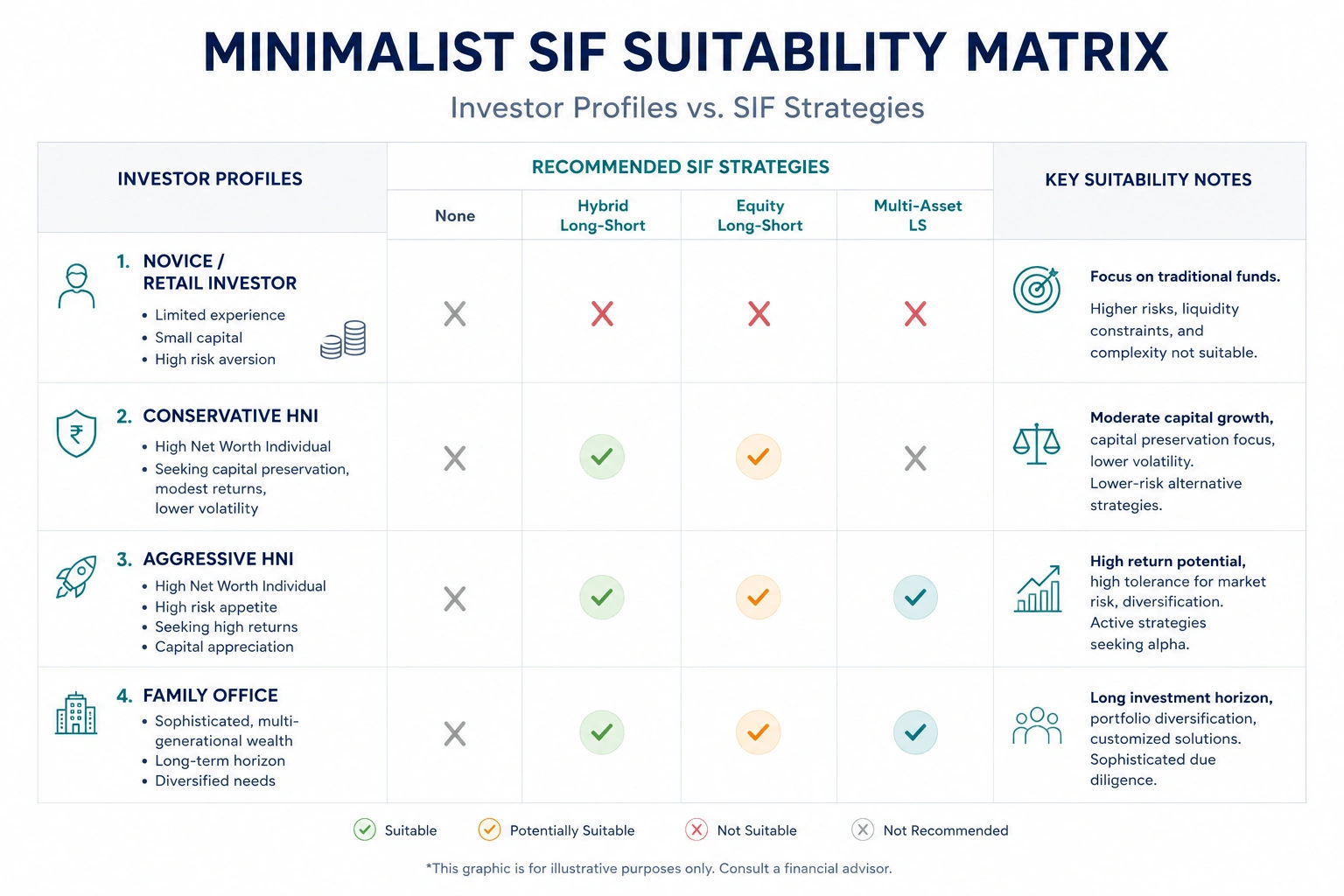
Keep SIFs as a satellite holding. A sensible allocation is 5% to 15% of your total equity portfolio. This gives you a defensive buffer without displacing your core wealth-building funds.
Rohan, 30, has a ₹1 crore portfolio. He puts ₹10 lakh (10%) into a Hybrid Long-Short SIF. When equity indexes drop 5%, his SIF portion drops only 1.5%, cushioning his overall portfolio and helping him avoid a panic sell on his other holdings.
One question that comes up often: what happens if the NAV drops below ₹10 lakh? You do not need to top up. The ₹10 lakh threshold applies only to the initial investment amount. However, you cannot make partial redemptions that bring your account balance below ₹10 lakh.
Questions people ask about Specialized Investment Funds
What is a Specialized Investment Fund (SIF) in India? A SIF is a new mutual-fund-like category introduced by SEBI in 2025. It allows fund managers to run advanced strategies like long-short equity and sector rotation with up to 25% unhedged short exposure, bridging the gap between traditional mutual funds and high-ticket PMS/AIFs. Only AMCs with a strong track record can launch them.
What is the minimum investment for SIF mutual funds? The minimum investment is ₹10 lakh per PAN aggregated across strategies under a single AMC. SEBI allows accredited investors to invest with a lower threshold of ₹1 lakh. Subsequent SIPs or top-ups can be smaller, but the initial ticket must meet this floor.
How are SIFs taxed in India? SIFs are taxed exactly like traditional mutual funds. Equity-oriented SIFs attract a 12.5% LTCG tax on gains over ₹1.25 lakh, and a 20% STCG tax. Debt-oriented SIFs are taxed at the investor’s income tax slab rates, subject to applicable surcharges and health and education cess.
Are SIFs open-ended or close-ended? SIFs can be open-ended with daily subscriptions or interval-based with designated transaction windows. Most equity SIFs are open-ended, while hybrid SIFs tend to use the interval structure to manage derivative liquidity without facing sudden redemption pressure.
What is the difference between SIF and PMS? SIFs are pooled mutual fund trust schemes with a ₹10 lakh minimum and mutual fund taxation — capital gains are deferred until redemption. PMS requires ₹50 lakh, creates individual demat accounts, and triggers capital gains on every buy/sell transaction the portfolio manager executes.
Who is eligible to invest in SIFs as an accredited investor? An accredited investor in India is an individual with annual income of at least ₹2 crore or net worth of ₹7.5 crore (with at least ₹3.75 crore in financial assets). They receive relaxation on the ₹10 lakh minimum, down to ₹1 lakh, after obtaining a certificate from a SEBI-recognized accreditation agency.
If you are in the ₹10 lakh bracket and your equity portfolio lacks a defensive sleeve, a single SIF allocation is a reasonable place to start. Check the AMC’s Scheme Information Document before you commit.
This article is for educational purposes only and does not constitute investment advice. Please consult a SEBI-registered investment advisor before making financial decisions.